
Nackawic, New Brunswick
NACKAWIC BUSINESS
FINANCING.
Nackawic sits on the middle Saint John west of the capital — a riverside industrial community whose private economy is the maintenance, fabrication, supply and hauling layer behind heavy industry: millwright and industrial-service contractors, welding and machine shops, heavy-equipment repair firms, forestry and freight carriers, parts and industrial suppliers, and the restaurants, stores and services of the town itself. BizFin.ca helps Nackawic-area businesses explore equipment financing, commercial vehicles, working capital and growth options through one Canadian review.
A business community within the rural community of Nackawic-Millville.
THE LAYER THAT KEEPS A MILL TOWN WORKING.
Nackawic was built as a company pulp town on the middle Saint John, and industry is still the reason the place exists — but this page is about who serves it. Within the Rural Community of Nackawic-Millville, the private economy is a dense service layer: industrial-maintenance and millwright contractors, machining, welding and fabrication shops, heavy-equipment and drive-line repair firms, forestry suppliers and scale operators, log and freight haulers, and the parts, fuel and industrial-supply operations that stock them all. Around that layer runs the ordinary commerce of a working town — restaurants, retail, accommodations, trades — and together they own a heavy, financeable asset base for a community of this size.
The financing needs come in two distinct shapes. Assets: shop lathes and machining centres, welding rigs and fabrication equipment, lifts and material handling, diagnostic systems, heavy trucks, tractors and trailers, mechanic and mobile-service units. Cash: parts and inventory bought ahead of the industrial jobs, supplier accounts, mobilization onto shutdown and outage work, payroll between collections, receivable timing on accounts that settle in arrears, fleet additions and shop growth. The two are covered separately below, on purpose — blending them is how files go wrong.
EQUIPMENT FINANCING IN THE NACKAWIC AREA.
Machining and fabrication equipment, lifts and material handling, tooling and diagnostics, forestry-support machinery.
COMMERCIAL VEHICLES IN THE NACKAWIC AREA.
Heavy trucks, tractors and trailers, mechanic and mobile-service units — business use only.
WORKING CAPITAL IN THE NACKAWIC AREA.
Parts and inventory ahead of the jobs, outage mobilization, payroll between draws, receivable timing.
NACKAWIC-AREA BUSINESSES SERVED.
Industrial-maintenance and millwright firms, fabrication and repair shops, carriers, suppliers, town commerce.
The community and its context
A SERVICE ECONOMY ON THE INDUSTRIAL RIVER.
Geography set this economy up: a big industrial facility on a big river, on the corridor between the capital and the upper valley, surrounded by working woodlands. The pulp mill has anchored the town since it was built — history this page acknowledges without leaning on, because any industry's future is not a financing promise — and the durable part is what grew around it: firms whose skills travel to any mill, mine or plant, and whose files stand on their own operations rather than on any single customer.
Municipally, the former town is today a community within the Rural Community of Nackawic-Millville; the businesses here operate like any others in the province, and a financing review reads them the same way. What matters to the file is what the business owns and what it bills — and in this economy, both are substantial.
Industrial maintenance and the metal trades
THE CONTRACTORS AND SHOPS BEHIND INDUSTRY.
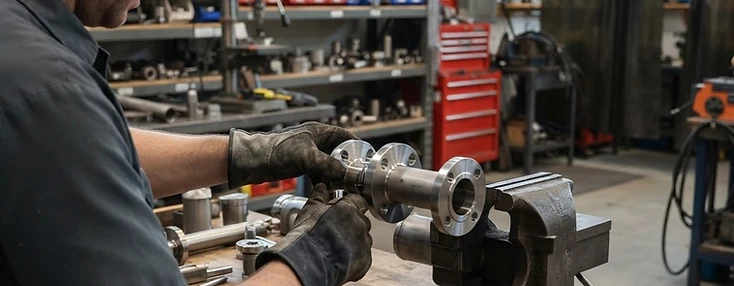
The signature private sector here is industrial service: millwright and mechanical contractors, electrical and instrumentation firms, machining and drive-line shops, welding and fabrication businesses, and the crane, rigging and hauling services that support them. Their work is shutdown-and-outage shaped — intense windows, demanding customers, invoicing that follows the job — and their shops carry real capital: lathes and mills, positioners and welding systems, lifts and gantries, tooling and diagnostics, trucks fitted out as mobile service units.
Those assets review on the work they perform. A fabrication shop adding a machining centre, a millwright firm equipping a second service truck, a repair business replacing a lift and its tooling at once — each prices on the operation it serves, with delivery, installation and rigging inside the same file where the program allows, and proven used machinery priced on the service life it has left.
Forestry supply, hauling and the fleet economy
THE WOOD, THE TRUCKS AND THE CORRIDOR BETWEEN.
Upstream of any industrial operation on this river is wood — and moving it is a business of its own. Log, chip and pulpwood carriers, forestry contractors and their suppliers, scale and woodyard services, fuel and parts operations, and the heavy shops that keep a fleet inspected all work from this corridor. It is owner-operator country: the operator usually owns the iron, and the iron is the file.
Commercial trucks are financed here strictly as working assets — a tractor-and-trailer set for a first haul, replacements paced across a small fleet, service and mechanic units for the shops — never as private vehicles. Late-model used units with their maintenance books price on the same basis as new, and where the program permits, truck, trailer and tools ride one file.
The town's own commerce and services
THE COUNTERS OF AN INDUSTRIAL TOWN.
Industrial towns run on their own commerce as much as on the industry: restaurants and take-out, retail and convenience, accommodations, personal and professional services, and the residential trades and property firms a settled community needs. Their asset lists are the standard small-commerce lists — kitchens and refrigeration, fixtures and point-of-sale systems, storage and handling gear, service and courtesy vehicles — and they review like any city firm's.
Their cash calendar follows the industrial rhythm: busy through the working seasons, thinner through the shutdowns and the deep winter. Sequencing that year — assets ahead of the busy stretch, cash through it, receivables bridged where they lag — is exactly the planning a review exists for.
Working capital, growth and succession
THE CASH BEHIND THE SHOPS AND THE NEXT OWNER.
Working capital in an industrial-service economy is timing, mostly: parts and materials stocked before the job, supplier accounts held open, crews mobilized onto outages and shutdowns, payroll carried between draws, invoices from industrial customers that settle weeks after the work. Add fleet growth, a bigger shop bay, a second service unit and the marketing that keeps an industrial name trusted, and the cash file stands on its own — no equipment request needs to be invented to open it.
Succession here means the service economy itself changing hands: a maintenance or fabrication firm sold as a going concern to the crew lead or the outside buyer who keeps it local, a carrier's units, contracts and shop passed to the driver who ran them, a family supply business moving between generations. Those files are real and reviewable — weighed on the business, its cash flow, the buyer's stake and the program behind the file, with nothing guaranteed in advance.
EXPLORE NEARBY NEW BRUNSWICK COMMUNITIES.

QUESTIONS ABOUT FINANCING IN NACKAWIC.
Ready to explore?