
Dieppe, New Brunswick
DIEPPE BUSINESS
FINANCING.
Dieppe has grown into one of Atlantic Canada's most dynamic Francophone business cities — a place where regional companies run in French, business parks line the airport and highway junctions, and commercial corridors draw customers from across the metro. BizFin.ca helps Dieppe businesses explore equipment financing, commercial vehicles, working capital and growth options — with service available in French or English, and a review that understands a bilingual market.
WHERE REGIONAL BUSINESS RUNS IN FRENCH.
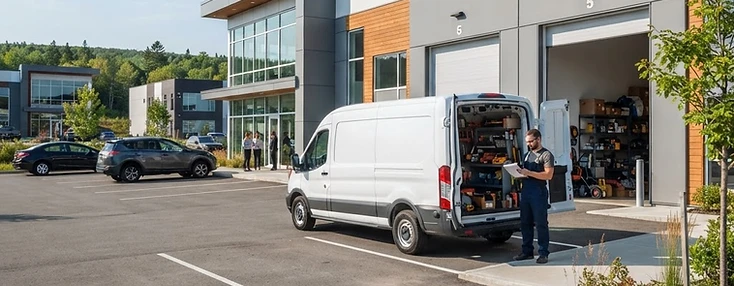
Dieppe is not a suburb with a name; it is a business city with its own gravitational pull. One of the few majority-Francophone cities in Canada outside Quebec, it has turned that identity into a commercial advantage: regional companies base themselves here to serve the Francophone market across the Maritimes, professional firms have grown into regional practices, and the business parks along the airport and Trans-Canada corridors have filled with distribution, manufacturing and service operations that ship and sell well beyond city limits. Growth of that kind leaves a paper trail of equipment lists, vehicle schedules and payroll runs — which is exactly where financing enters.
The financing story here has two halves, and they deserve separate treatment. The first is assets: contractor packages, warehouse and material-handling equipment, shop tools, restaurant kitchens, delivery vans and straight trucks, office and business technology. The second is cash: inventory for commercial corridors that run on traffic, staffing for a service business in growth, the gap between invoicing a regional client and being paid. This page walks through both, the way a Dieppe business owner would actually plan them.
EQUIPMENT FINANCING IN DIEPPE.
Contractor packages, lift trucks and dock equipment, production machinery, commercial kitchens and refrigeration, practice technology.
COMMERCIAL VEHICLES IN DIEPPE.
Delivery vans, straight trucks, service and contractor vehicles, courier fleets — business-use only.
WORKING CAPITAL IN DIEPPE.
Corridor inventory, staffing, project mobilization, receivable timing, marketing and growth costs.
DIEPPE INDUSTRIES SERVED.
Airport-district logistics, light manufacturing, retail and hospitality, professional services, construction trades.
A Francophone business community
ENTREPRENEURSHIP THAT WORKS IN TWO LANGUAGES AT ONCE.
Dieppe's business community is one of the most visibly Francophone in Canada outside Quebec, and that is an operating fact, not a heritage note. Firms based here serve customers in French across New Brunswick and the wider Maritimes while running bilingual operations that reach English-speaking markets just as easily; contractors, distributors and service companies use the city as a base for a region where both languages are working languages. For a financing platform, bilingual service is not a courtesy — it is part of reading a file properly. A Dieppe review can run in French from the first request to the final documents, with the same range of equipment, vehicle and working-capital options behind it.
The community also runs on its own networks: business associations, sector groups and a merchant culture that treats growth as normal. That environment shows up in the files — established Francophone family firms planning a second generation of ownership, younger founders launching service businesses into a market they already know, and mid-sized companies professionalizing their operations. Each stage has its financing shape, and the review reads the stage as carefully as the numbers.
Commerce at the airport junction
BUSINESSES THAT FLY OUT OF THE JUNCTION.
The region's international airport sits inside Dieppe's boundaries, and the private commerce around it — cargo and logistics firms, warehouses and couriers, fleet operators, the hotels and hospitality businesses that serve a travelling public — makes up one of the city's most concentrated business districts. The airport itself is public infrastructure and never a financing target; the audience here is the layer of private companies that route goods, people and services through the junction it creates, plus the conference-scale hospitality that follows it.
Those businesses share a logistics-shaped asset list: lift trucks and dock equipment for the warehouse operators, cargo-body and delivery vehicles for the couriers, shuttle and service fleets for the operators, and a working-capital calendar built on volume swings, fuel and driver payroll. Files from this district tend to be well structured — the equipment is business-use by definition and the revenue behind it is documented — and they review accordingly.
Business parks and light manufacturing
INDUSTRIAL BAYS, FILLED AND FILLING.
Dieppe's industrial parks have been one of the quiet engines of the metro's growth: light manufacturing, food and commercial processing, building-products suppliers, equipment dealers, fabrication and repair operations, and the distribution-adjacent producers that sit close to the highway junction. An industrial-park tenancy is a strong starting point for an equipment file — the premises anchor the operation, and the asset list, from production machinery and packaging lines to material handling, tooling and shop systems, is usually specific, quoted and insurable.
Expansions here rarely stop at one machine: a producer that adds a line also adds handling, storage and often a vehicle. Where the program allows, complete eligible equipment packages — with delivery and installation costs where the program permits — can be reviewed as a single acquisition, which is how an industrial bay actually grows. Used machinery with a documented history belongs in the same conversation at the right price.
Retail corridors and hospitality
THE CORRIDORS THAT PULL A REGION OF SHOPPERS.
Dieppe carries some of the heaviest commercial and retail traffic in New Brunswick: shopping corridors, big-box and boutique retail, restaurants and cafés, hotels and service businesses that draw from the whole metro and a wide visiting public. The asset profile is the classic commercial one — fit-out and fixtures, commercial kitchens and refrigeration, point-of-sale and booking technology, housekeeping and laundry equipment — and the cash profile is traffic-driven: inventory bought for the season, staff hired for the rush, receivables timed to household and corporate accounts.
Financing for this layer follows the calendar rather than the fiscal year. Equipment lands ahead of the busy season; working capital covers the stock-and-staff build and the quieter weeks after; an expansion — a second location, a renovated dining room, a broader inventory — is timed to open in front of demand. The review can sequence those needs instead of forcing them into a single generic product.
Professional services and head offices
A HEAD-OFFICE ECONOMY WITH ITS OWN ASSET LIST.
Alongside the industrial parks sits a professional layer that runs the region's administration in both languages: accounting and legal practices, insurance and financial-services firms, engineering and design offices, technology-enabled service businesses and regional headquarters. Their equipment is lighter — workstations and servers, specialized software and hardware, client-facing fit-out — but their investment is in people, and people are financed differently: hiring classes, project mobilization, receivable gaps between engagement and payment.
Working capital is the natural centre of these files. A practice that wins a regional contract often has to staff it before billing it; a firm that grows a client base carries the gap between proposal and retainer. The review treats those rhythms as the business itself — and keeps the modest equipment files, where they exist, separate from the cash needs they should never be mixed with.
Equipment financing in Dieppe
FROM CONTRACTOR PACKAGES TO RESTAURANT KITCHENS.
The equipment list across Dieppe reads like a cross-section of its economy: contractor and trades packages for the construction side; lift trucks, racking, dock and packaging equipment for the warehouse side; production machinery, tooling and material handling for the light-manufacturing side; commercial kitchens, refrigeration and fixtures for the retail and hospitality side; and the office, practice and retail technology that runs the professional and commercial layer. Business-use assets across that whole range are the bread and butter of equipment financing.
Two practical notes make Dieppe files efficient. First, complete eligible packages often review better than piecemeal purchases — a quote or an equipment list covering the whole acquisition gives the file its real shape. Second, used equipment with service records is welcome where the remaining life justifies the price, and delivery or installation costs can travel with the package where the program allows.
Commercial vehicles in Dieppe
THE VEHICLES BEHIND THE COMMERCIAL CORRIDORS.
Delivery vans and straight trucks for the corridor and airport-district businesses, service vans and contractor pickups for the trades, cube vans for the couriers, shuttle and crew vehicles for the operators — the vehicle file in Dieppe is as commercial as it gets, and it is reviewed that way. A vehicle with a route, a contract or a service book behind it is a business asset with a story, and business-use financing is built for exactly that.
Structure follows the operation: a single addition for the business buying its first dedicated delivery unit, staged renewals for the fleet refreshing in pieces, a fuller program for the operator scaling all at once. Late-model used units with maintenance records belong in the same review — the question is always what the vehicle does for the business, not what the odometer says.
Working capital, growth and succession
THE CASH LAYER — AND THE NEXT GENERATION OF OWNERS.
The working-capital list in Dieppe is a commercial one: inventory bought ahead of corridor traffic, supplier payments taken at discount, staffing for a service business in growth, project mobilization before the first invoice clears, receivable timing when regional clients pay on their own schedule, marketing to stay visible in a competitive market. None of it is equipment, all of it is financeable, and keeping the two deliberately apart is what makes each side cleaner.
Growth in a Francophone business community often has a family shape: an established firm passing to the next generation, a partner buyout, a purchase of a business whose name already carries the market. Acquisition and succession files are real, reviewable files here — structured around the business, its cash flow and the program behind the file, never a promise made in advance. Expansion financing blends the same pieces: assets for the new site, cash to carry it to maturity.
Working capital financingBusiness growth financingBusiness expansion financing
EXPLORE NEARBY NEW BRUNSWICK COMMUNITIES.

Moncton
Greater Moncton / Southeast
Distribution and logistics hub at the highway-rail junction, with bilingual head-office commercial services.
Business financing in Moncton
Riverview
Greater Moncton / Southeast
South-river contractor and service economy supporting the metro hub.
Business financing in Riverview
Shediac
Greater Moncton / Southeast
Acadian coastal tourism and lobster-boat economy by the warm-water beaches.
Business financing in Shediac