
Miramichi, New Brunswick
MIRAMICHI BUSINESS
FINANCING.
Miramichi is a river city that serves an enormous territory — a place where the forestry supply chain, regional trades, transportation and a genuine visitor season all do business along the same water. BizFin.ca helps Miramichi businesses explore equipment financing, commercial vehicles, working capital and growth options — one request, reviewed by a Canadian team that understands an economy built on wood, work and distance.
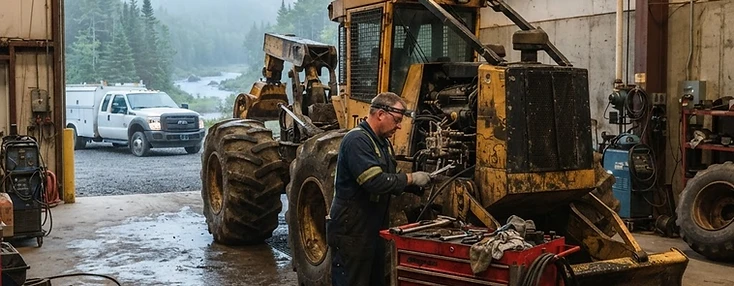
THE RIVER CITY THAT KEEPS A REGION WORKING.
Miramichi's geography explains its economy: a city of its size sits at the mouth of a river system because the river once carried the region's logs, fish and freight — and it still carries the region's business. The modern version of that role is a diversified service and supply economy spread across several sectors rather than leaning on any single operation: forestry contractors and wood-products businesses, repair and fabrication shops, construction and trades firms, trucking fleets, marine and river-linked services, and a tourism season built on one of the world's famous salmon rivers. Breadth of that kind is a strength — and in financing it shows up as a range of very different files.
The businesses in that mix own real assets and carry real cash cycles: harvesting and forwarding equipment, welding rigs and shop tools, gravel trucks and service pickups, kitchen lines and lodge gear — and the mobilization costs, supplier terms and receivable gaps that come with territory work. This page covers both sides in Miramichi terms.
EQUIPMENT FINANCING IN MIRAMICHI.
Forestry-support machinery, welding and shop equipment, construction and excavation gear, kitchen and lodge equipment.
COMMERCIAL VEHICLES IN MIRAMICHI.
Logging and gravel trucks, tractors and trailers, service pickups, cargo vans — business-use fleets.
WORKING CAPITAL IN MIRAMICHI.
Fuel and parts ahead of the season, job materials, seasonal staffing, receivable gaps from a wide territory.
MIRAMICHI INDUSTRIES SERVED.
Forestry supply chain, repair and fabrication shops, construction trades, trucking, tourism and hospitality.
Forestry and the wood economy
A WOOD ECONOMY BIGGER THAN ANY MILL.
Forestry remains the deepest current under Miramichi's economy — not as a single-employer story but as a supply chain: woodlands contractors, harvesting and hauling operations, sawmilling and wood-products businesses, the machine shops and repair services that keep that equipment running, and the suppliers who feed it all. A sector like that generates a distinctive asset list — processors, forwarders, loaders and trailers, grapple and delimbing gear, shop equipment built heavy enough to work on it — and a distinctive cash rhythm, where woodlands work is paid by volume delivered and the costs come first.
Forestry files have their own review logic: the equipment is specialized and business-use by definition, seasonal cycles matter, and documentation — hours, maintenance, service records — carries real weight. Whether the operation is a contractor adding a unit, a transporter renewing a fleet or a supplier expanding a shop, the structure follows the work the machine actually does.
The regional service centre
SHOPS, TRADES AND SERVICES FOR A WIDE TERRITORY.
A city at the centre of a big territory collects the territory's service economy: automotive and equipment repair, machine and welding shops, fabrication, building trades, health and personal services, retail and professional businesses that draw customers from well beyond city limits. Those operations share a profile — skilled owner-operators, serious tool and shop investments, and growth that arrives as reputation spreads across the map rather than as one big contract.
Financing for this layer is often about timing: the shop that needs a heavier lift before the next job arrives, the trades business adding a second crew, the service firm computerizing its scheduling and records. Modest files, reviewed properly, move fastest when the asset, the revenue and the need all line up in one clear story.
Construction and trades
BUILDING FOR A CITY AND ITS HINTERLAND.
Miramichi's construction sector builds for both the city and the wide rural territory around it — residential projects, commercial builds, institutional work and the renovation and specialty trades that follow. The asset needs are the classic contractor ones: excavators and compact equipment, service and crew trucks, trailers, tool packages, and the shop equipment a serious operation maintains between jobs.
Construction cash follows its own calendar: crews and materials are paid before the first progress cheque clears, and holdbacks sit at the end of the job. Keeping equipment files and working capital deliberately apart is how a contractor stays liquid enough to bid the next project instead of waiting on the last one.
Trucks and the regional haul
FLEETS BUILT FOR DISTANCE AND LOADS.
Distance is the operating condition of the whole region, and Miramichi runs the fleets that cover it: logging and chip trucks off the woodlands roads, gravel and aggregate trucks for the construction calendar, freight and service vehicles for the businesses that ship into and out of the territory. Every one of those units is a business-use asset with a duty cycle attached, and duty cycles are what commercial-vehicle files are built on.
The review reads the operation behind the truck: the haul, the contract or customer book, the maintenance discipline, and whether the next unit is an addition, a renewal or the start of a bigger program. Used late-model units with honest records belong in exactly the same conversation — timber country knows the difference between a tired truck and a well-kept one.
The river and the visitor season
A SALMON RIVER THAT FEEDS A SEASON.
The Miramichi's reputation as a salmon river supports a genuine visitor economy: lodges and outfitting operations, guides and outfitting services, restaurants, accommodations and the retail that serves a travelling public. Those businesses carry the classic seasonal shape — assets and inventory placed ahead of the season, revenue concentrated inside it, and quieter months that still have payroll, heat and maintenance in them.
Seasonal financing is a specialty of its own: equipment and lodge improvements financed to land before opening, working capital that bridges the shoulder weeks and the receivable tail of the season, and expansions — more rooms, a bigger kitchen, a second service line — scheduled against the calendar instead of against the year. A review that understands seasons structures the file accordingly.
Equipment financing in Miramichi
HEAVY-DUTY EQUIPMENT FOR A HEAVY-DUTY ECONOMY.
The Miramichi equipment list runs toward the durable end: forestry-support machinery and trailers, welding and fabrication equipment, machine-shop tools, construction and excavation equipment, material handling, commercial kitchen and lodge equipment, and the service rigs that bring the repair to the customer. Across all of it the review questions are the same — what the asset does for the business, what it costs against the life it has left, and how the acquisition fits the operation's plan.
Packages matter as much as units here: a shop expansion is rarely one machine, and where the program allows, complete eligible equipment acquisitions — including delivery and installation where permitted — can be reviewed together. Used equipment with documented hours and service history is a normal, welcome part of files in a region where machines are judged by maintenance, not age.
Commercial vehicles in Miramichi
TRUCKS AND SERVICE VEHICLES THAT EARN THEIR KEEP.
The vehicle list is honest about the territory: highway and bush-condition tractors and trailers for the wood and freight hauls, straight trucks for regional delivery, service and crew pickups for the trades, cube and cargo vans for local service routes, and the mobile-service rigs that put a shop on the road. Commercial-vehicle financing is for business use — every unit on this list earns its keep or it doesn't belong in the file.
Because duty cycles vary so much here, the structure varies with them: single additions for operators growing one unit at a time, staged fleet renewals for established haulers, and full fleet programs where the operation justifies them. Records and history — hours, routes, maintenance — are what separate a strong file from a thin one.
Working capital and growth
THE CASH THAT COVERS THE DISTANCES.
Territory economies run on working capital: fuel and parts ahead of the woodlands season, materials bought for the job before the job pays, inventory stocked for a short busy season, payroll through the weeks when the calendar is thin, receivable gaps when remote clients pay on their own schedule. Those needs are financeable on their own terms — the review treats them as the operation's real rhythm rather than as a footnote to an equipment file.
Growth here shows up as capacity and ownership changes: a second truck and the contract to fill it, a shop bay added to a busy repair business, a purchase of an established local firm whose customers already know its name. Expansion and succession files are reviewable files — built on the business, its cash flow and the program behind it, with options laid out as they actually stand.
EXPLORE NEARBY NEW BRUNSWICK COMMUNITIES.

Moncton
Greater Moncton / Southeast
Distribution and logistics hub at the highway-rail junction, with bilingual head-office commercial services.
Business financing in Moncton
Fredericton
Fredericton / Capital Region
Capital-region professional services, technology and river-corridor private economy.
Business financing in Fredericton